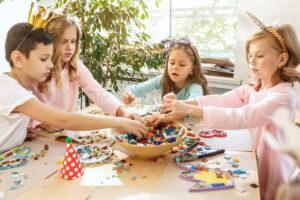
Creative ideas and educational materials for childrenEducation for children is a fascinating process that requires commitment, creativity, and the right tools. This article presents a wide range of ideas and educational materials that can significantly enrich the teaching and learning process for children of various ages.
Creative ideas and educational materials for children.
Education for children is a fascinating process that requires commitment, creativity, and the right tools. The right approach to learning can make it not only effective but also enjoyable. In this article, we present various ideas and educational materials that can enrich the teaching and learning process for children of different ages.
The importance of creative educational materials.
Creative educational materials play a key role in a child’s development. They stimulate imagination, develop cognitive skills, and support learning through play. The use of diverse teaching aids allows for the adaptation of the educational process to the individual needs of each child.
Some of the most effective educational materials include:
Worksheets: These are versatile tools that cover various fields of knowledge, from mathematics to the Polish language. Colorful, attractively designed cards capture children’s attention and encourage learning.
Educational games: They combine learning with fun, making the acquisition of knowledge enjoyable and effective. These can be board games, card games, or interactive applications that develop mathematical, language, and logical thinking skills.
Reading sets: These include books, boards, and cards that help develop reading skills. Methods such as global reading or syllable learning can be effectively supported by appropriately selected materials.
Mathematical aids: Tools such as abacuses, mathematical blocks, or special cards for learning arithmetic operations help in understanding abstract mathematical concepts.
Creative ideas for educational play.
Creative educational play can significantly diversify the learning process. Here are some ideas:
Building forts and hideouts: Using cardboard boxes or blankets, children can develop creativity and spatial skills. This type of play stimulates imagination and manual dexterity.
Simple scientific experiments: Experiments that can be conducted at home spark curiosity and teach the basics of the scientific method. Examples include experiments with soap bubbles, colorful liquids, or nature observations.
Sensory play: Activities with modeling compounds or kinetic sand engage various senses and stimulate sensory and motor development in children.
Modern technologies: E-learning, interactive applications, or educational programs can effectively complement traditional teaching methods. It is important to use them in a balanced way, tailored to the child’s age.
Creating personalized educational materials: Work sheet generators and custom educational games allow for tailoring content to the individual needs and interests of the student.
The role of parents and teachers
Effective use of educational materials requires engagement from adults. Parents and teachers should actively participate in the educational process. It is important to create a positive atmosphere conducive to learning and experimentation.
The role of adults includes:
- Selecting appropriate materials and teaching methods.
- Supporting the child in learning, motivating them, and helping them overcome difficulties.
- Creating regular educational rituals, such as reading books together or solving puzzles.
Creative ideas and educational materials form the foundation of effective learning. By combining traditional methods with modern technologies, it is possible to create an inspiring educational environment that supports the holistic development of the child.
The importance of diversity in education.
It is worth remembering that every child is different and has their unique preferences and learning styles. Experimenting with various materials and methods allows for discovering those that work best for a particular student. Interdisciplinarity in education – combining different fields of knowledge – can help in better understanding the surrounding world and developing critical thinking.
The joy of learning.
Most importantly, the learning process should be enjoyable and motivating. Encouraging children to continuously explore and learn makes them more open to new challenges. A creative approach to education, diversity of materials and methods, and adapting them to the individual needs of the child can yield surprising results. Learning becomes not just an obligation but a fascinating adventure that shapes the future of the young person.
It is worth investing time and energy in developing children’s skills. The creative ideas and educational materials offered can help in this, making the learning process inspiring and joyful.